
The most important traffic rules for school students are simple: walk on the footpath or the far left edge, cross only at a zebra crossing or with a green walking signal, wear a helmet on a cycle or scooter, belt up whenever you ride in a car, and stay seated in the school bus or van. In India we drive on the left side of the road, so traffic coming close to you on your side arrives from the right. This page explains each rule in easy words, shows how Indian signs and signals work, and gives parents and teachers a short plan for the school gate. You can also press the buttons on the working traffic light on this page to see the red, amber and green order for yourself.
Quick facts
Keep left
Indian roads follow left-hand driving, so look right first before you step off the kerb.Zebra crossing
Cross only on the white stripes, at a subway, at a foot overbridge or with the green walking person.Helmet always
Every rider and every pillion, children included, wears a fastened helmet on a two-wheeler.Seat belt
In a car, children sit in the back seat with the belt across the chest and lap.Bus and van
Stay seated, keep hands and head inside, and get down only when the vehicle has fully stopped.Three sign shapes
Red circle means a rule you must obey, red triangle means take care, blue rectangle gives information.
Traffic rules for school students at a glance
Before we go into detail, here is a quick list you can read aloud in class or stick near the door at home. These school traffic rules are the same in a big city or a small town.
| When you are | The rule |
|---|---|
| Walking | Use the footpath. If there is none, walk on the far left edge in a single line. |
| Crossing | Stop at the kerb, look right, left and right again, then cross straight without running. |
| Near a signal | Wait for the green walking person. A red standing person means wait. |
| Cycling | Ride on the left, one behind the other, with a helmet and working brakes. |
| In the school bus | Queue at the stop, sit down, and never put an arm out of the window. |
| In a van or auto | Do not hang at the door or sit on the driver's side. Tell an adult if it is overfull. |
| In a car | Sit at the back with the seat belt on. Open the door on the footpath side. |
| On a scooter | Wear a helmet with the strap locked, hold on firmly and keep feet on the footrest. |
| At night or in rain | Wear light colours, carry a small torch and walk slower on wet roads. |
| Always | No phone or earphones while crossing. Eyes and ears on the road. |
Teachers often turn this list into a traffic rules activity in school: each child picks one row, acts it out and the class guesses the rule.
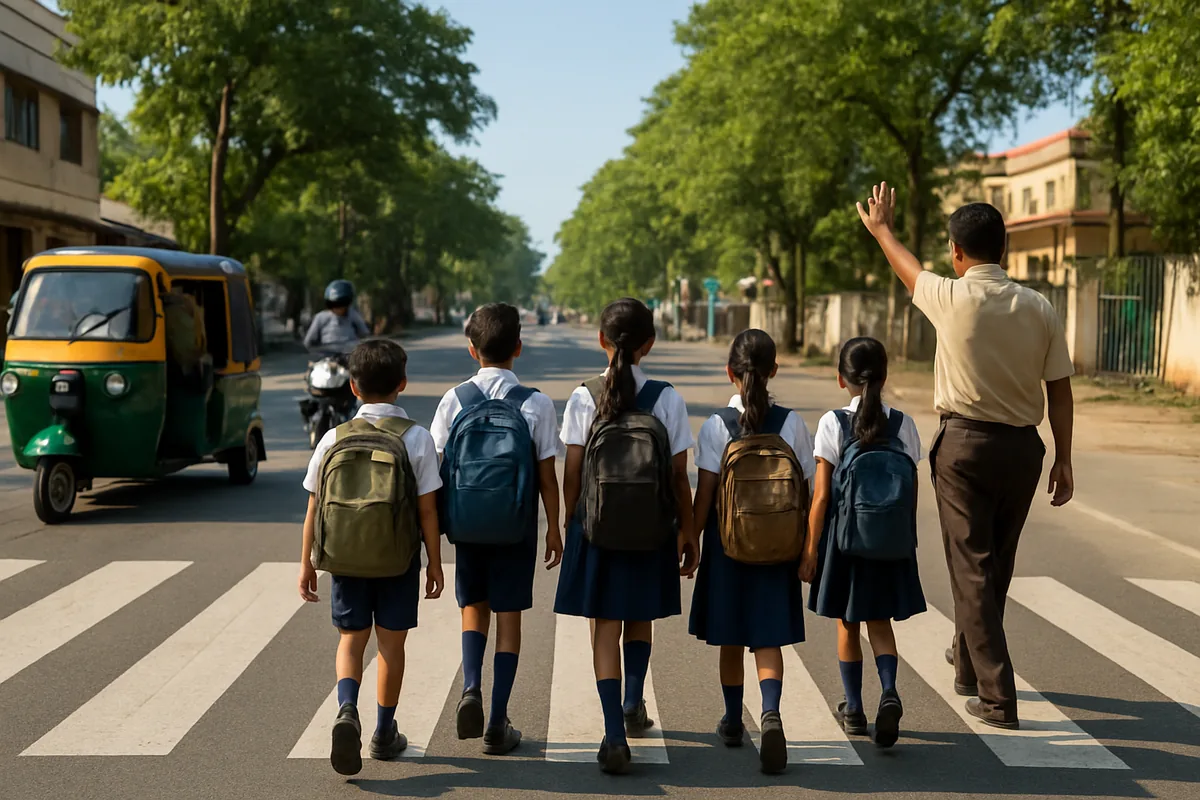
Walking to school without worry
Many Indian children walk to school, at least for the last part of the way. Walking is healthy and fun, but the road is shared with buses, trucks, autos and two-wheelers, so a few habits keep you safe.
- Use the footpath whenever there is one. If shops or parked vehicles block it, step out only as far as needed and come back quickly.
- Where there is no footpath, walk on the extreme left edge, facing the side that is clearest, and stay in a single file with friends.
- Hold a younger brother or sister by the hand, and keep yourself on the traffic side so the little one is protected.
- Never play, chase or kick a ball on the road. A school traffic jam at the gate is not a playground.
- Look out for vehicles coming out of gates, lanes and petrol pumps. Drivers may not see a small child.
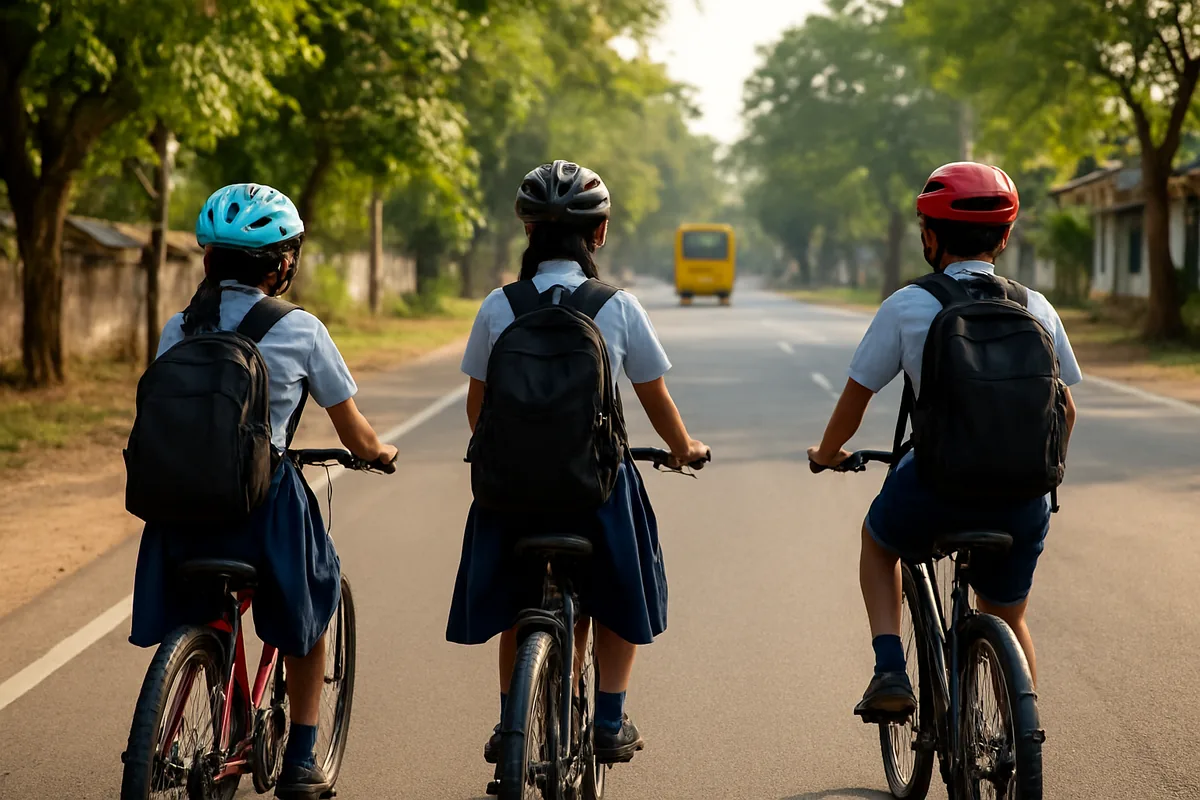
Riding a cycle to school
A cycle gives freedom, but it is also a vehicle, so the rider must follow road rules just like a driver.
- Check the cycle before you leave: both brakes, air in the tyres, a bell that rings, and a red reflector at the back.
- Wear a cycle helmet and fasten the strap under the chin.
- Ride on the left side, close to the edge, and go in a line, not side by side.
- Give a hand signal before turning: right arm straight out for a right turn, left arm out for a left turn.
- At a busy junction, get down and walk the cycle across on the zebra crossing.
- Never hold on to a moving bus or truck, never carry a friend on the carrier, and keep both hands on the handle.
Park the cycle only in the school stand, never across the gate where buses and parents need space.
School bus and school van rules
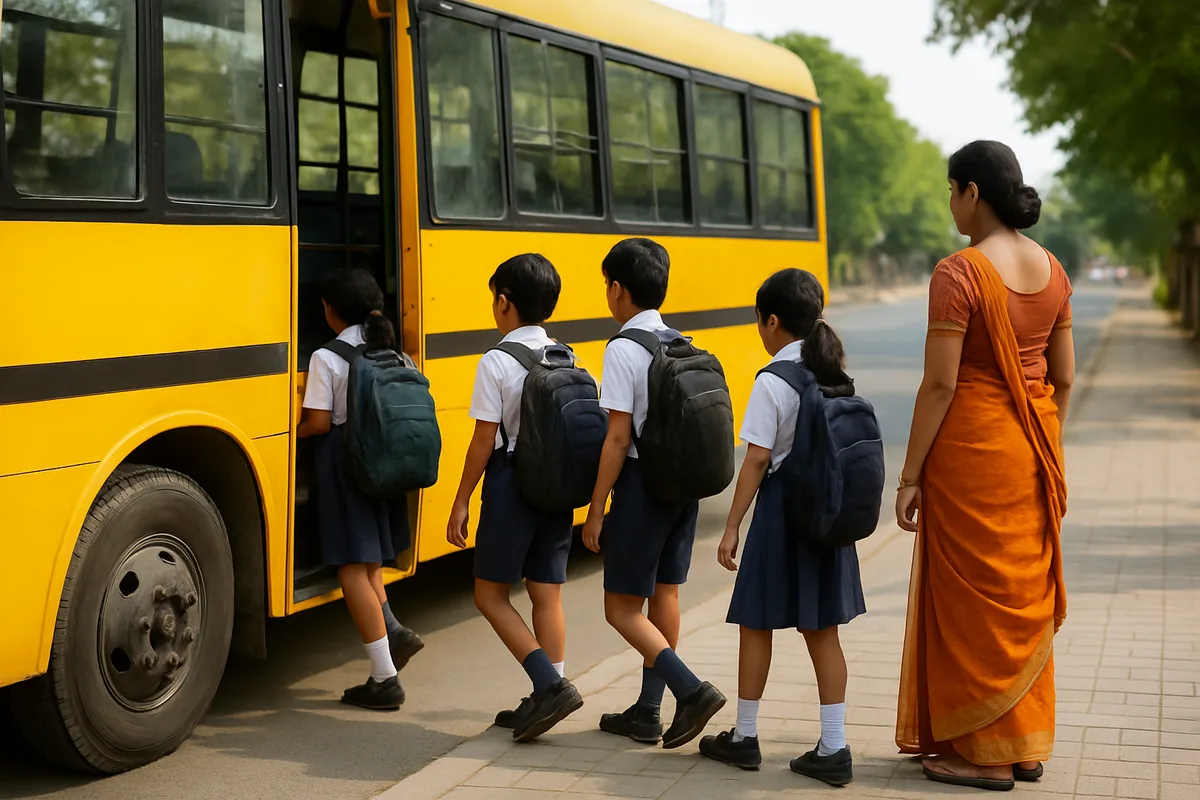
Lakhs of children travel in a school bus in traffic every day. School buses in India are usually painted yellow and are expected to have a first aid box, a fire extinguisher, a speed governor, grills on windows and an attendant on board. These are the traffic rules for school bus riders:
- Reach the stop a few minutes early and wait on the footpath, well away from the road.
- Let the bus stop fully before moving towards the door. Climb in one by one using the hand rail.
- Sit down quickly, keep your bag on your lap or under the seat, and do not stand in the aisle.
- Keep your head, hands and bottles inside the windows at all times.
- Do not shout or distract the driver. Listen to the attendant.
- After getting down, walk away from the bus. If you must cross, wait until the bus leaves so you can see the road clearly. Never cross in front of or behind a standing bus.
The same rules apply to a school van or an auto rickshaw. If a van is packed with too many children, or the driver uses a phone while driving, tell your parents or class teacher the same day.
Being a safe passenger in a car, scooter or auto
Even when someone else is driving, the passenger has a job too.
In a car
Children should sit in the back seat. Put the seat belt on before the car moves, with the belt across the shoulder and lap, not behind the back. Small children need a child seat that suits their size. Get out on the footpath side, never on the road side.
On a scooter or motorcycle
Every pillion rider, including a child, wears a helmet that fits and is locked. Sit behind the rider with both feet on the footrests and hold the rider's waist. Never stand in front of the rider on the floorboard.
In an auto rickshaw or cab
Sit well inside, not at the edge. Do not let more people squeeze in than the seat allows. Keep hands inside, especially in narrow lanes.
A good passenger also helps the driver: no loud games, no tapping on the driver's shoulder, and a gentle reminder if the adult picks up a phone while driving.
How to cross the road the right way
Crossing is the moment when most children get hurt, so practise this routine until it is automatic. Remember that in India vehicles keep left, so the nearest lane of traffic comes from your right.
- Find a safe place: a zebra crossing, a signal with a walking person, a subway or a foot overbridge. Avoid bends and spots between parked cars.
- Stop at the edge of the footpath. Do not step on the road yet.
- Turn your head to the right, to the left, and to the right once more. Listen for horns and engines too.
- When the road is clear, or all vehicles have stopped, walk straight across. Do not run and do not stop in the middle.
- Keep looking both ways as you cross, because a two-wheeler can appear suddenly.
- On a wide road with a divider, treat each half as a separate road and repeat the checks.
How signs and signals work in India
Road signs in India are grouped by shape and colour, so you can understand a sign even before you read its picture.
| Type | Shape and colour | Meaning | Example |
|---|---|---|---|
| Mandatory | Red circle | A rule you must follow | Stop, No entry, Speed limit |
| Cautionary | Red-bordered triangle | Warning of danger ahead | School ahead, Pedestrian crossing |
| Informatory | Blue rectangle | Helpful information | Hospital, Parking, Petrol pump |
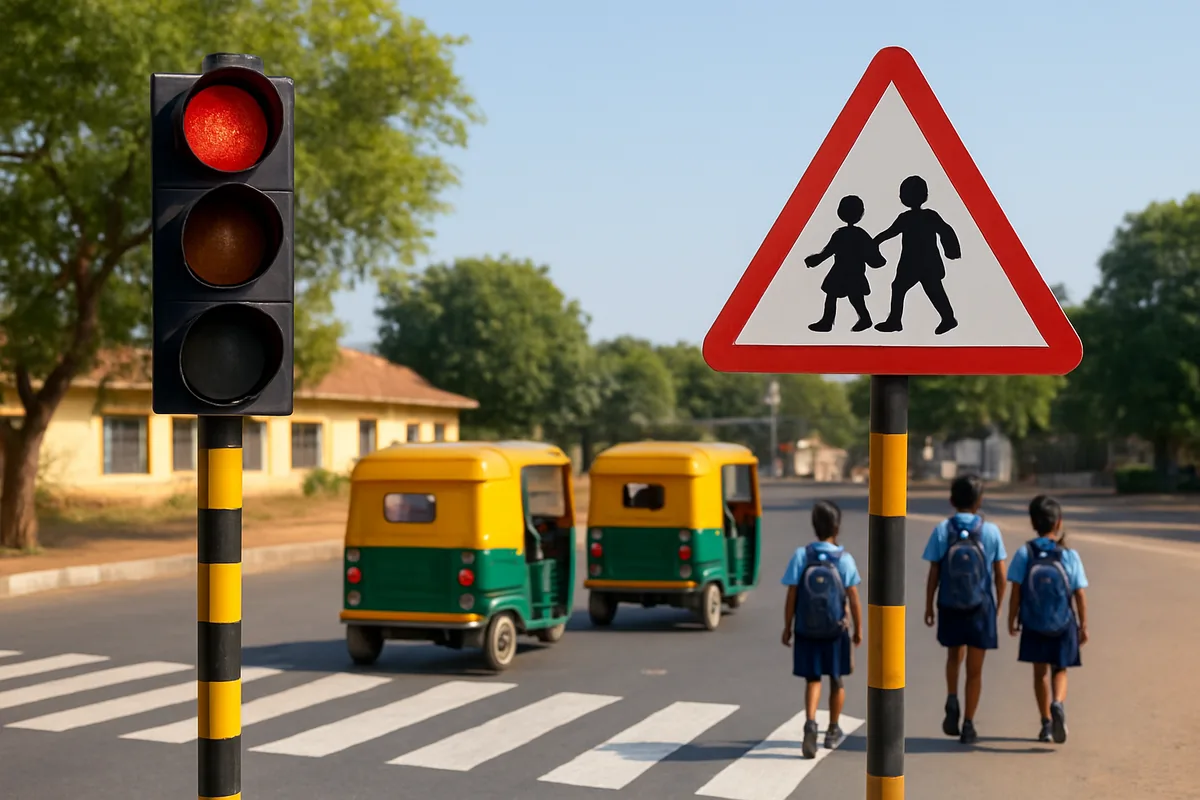
The sign students meet most is the School Ahead sign, a red-edged triangle showing a pair of children on their way to class. Read the full guide on the school ahead sign to know where it stands and what drivers must do.
Traffic lights
A traffic light has three lamps. Red means stop behind the line. Amber warns that red is coming next, so get ready to halt. Green means go, but only if the road ahead is clear. Many junctions also have a pedestrian light with a red standing person and a green walking person. Try the buttons on the working traffic light on this page, then see how signals are used near schools on traffic lights at school.
Traffic police hand signals
When a junction is busy or the lights fail, an officer controls traffic by hand. A raised palm facing you means stop. A beckoning arm means come forward. An arm stretched out to the side stops traffic from that side. Drivers and walkers must obey these signals.
Everything on this site in one table
This site covers road safety for students, school projects, charts and a few practical topics for parents who drive. Pick the page you need:
| Page | What you will find | Best for |
|---|---|---|
| School ahead sign | Shape, placement and meaning of the warning sign near schools | Students, drivers |
| Traffic lights at school | What each light means, a classroom game and rhymes | Classes 1 to 5 |
| Traffic light project | Cardboard model and battery LED model with steps | Project day |
| Smart traffic light | A sensor based model that changes green time | Science fair, classes 6 to 10 |
| Classroom light chart | A red, amber and green chart for class behaviour | Teachers |
| Traffic rules chart | Ideas and layout for a rules chart | Chart work, notice boards |
| Traffic ticket and e-challan | How to check and pay a challan on the official portal | Parents who drive |
| Driving test result | Checking a licence test result on the official portal | Older students, parents |
| Defensive driving | Habits that prevent crashes before they happen | New drivers |
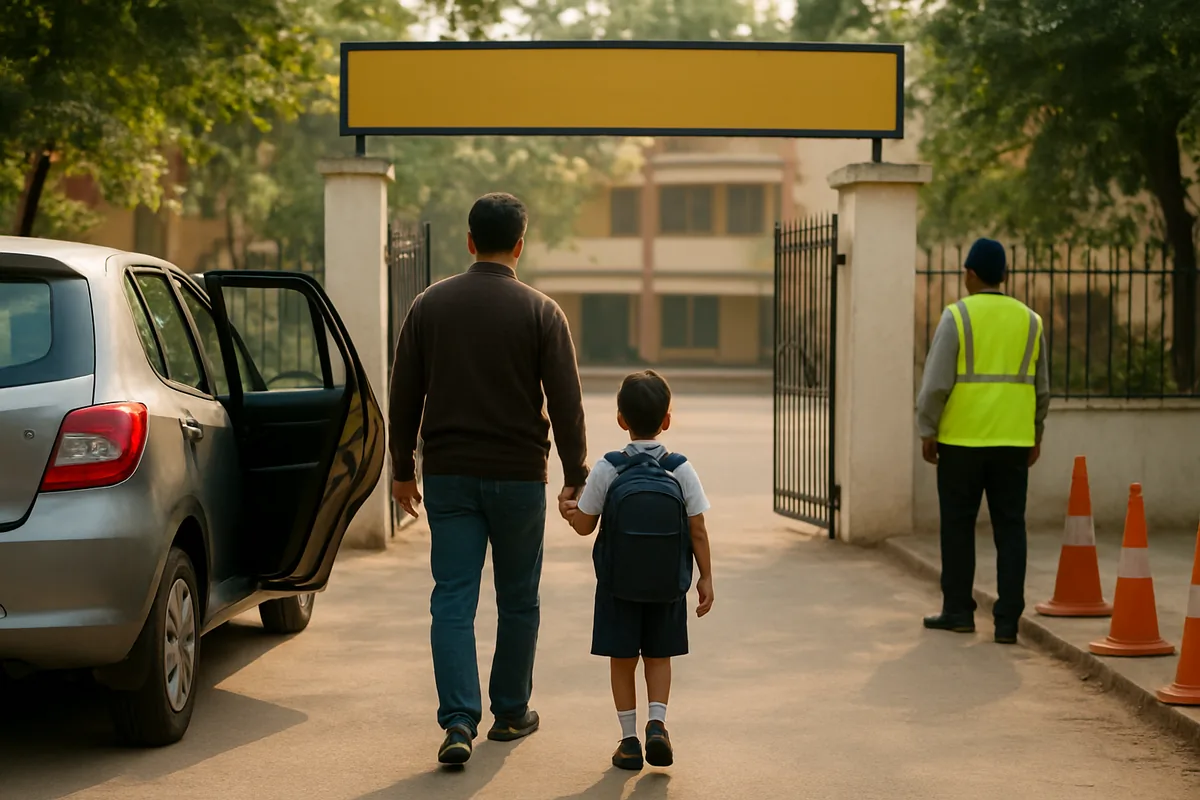
For parents and teachers: safe drop-off and the school zone
Most school traffic trouble happens in the fifteen minutes before the bell and after it. A few shared habits make the gate calmer for everyone.
- Drop on the school side. Stop on the same side as the gate so the child does not cross the road alone.
- No double parking. A car stopped beside another car blocks buses and hides children from view.
- Slow in the zone. Near the School Ahead sign, drive at walking pace, do not overtake and do not honk at children.
- Kiss and go. Say goodbye in the car, let the child step out on the footpath side, and move on.
- Be the example. Children copy adults. Wear the helmet, buckle the belt and wait for the green, even when late.
Teachers can run a short safety week each term. Ideas include a walk to the nearest crossing, a chart competition using the traffic rules chart page, a red and green behaviour board from the classroom light chart page, and a model from the traffic light project guide. The Ministry of Road Transport and Highways also shares road safety material that schools can use.
Practise the rules with games and the signal tool
Rules stick better when children act them out. Here are three quick ideas for home or class:
- Red light, green light. One child calls the colours while the others walk, slow down or freeze.
- Spot the sign. On the way to school, count how many red circles, red triangles and blue rectangles you see.
- Be the officer. One child gives hand signals, the rest act as vehicles and walkers.
For the light game, keep the working traffic light on this page open on a phone or classroom screen and let children take turns pressing the buttons. Then ask: what should a walker do now, and what should a driver do?
Questions people ask
What are the basic traffic rules for school students in India?
Walk on the footpath or the far left edge, cross at a zebra crossing after looking right, left and right, and obey the walking signal. Wear a helmet on any two-wheeler, buckle up in the back seat of any car, and stay seated in the school bus or van.
Why should Indian children look right first when crossing?
India follows left-hand driving, so the lane closest to you when you step off the footpath carries traffic coming from your right. After that you look left for the far lane, and right once more because things change quickly.
What should my child do after getting off the school bus?
Walk away from the bus to the footpath and wait for it to leave before crossing. A child standing just in front of or behind a bus is in the driver's blind spot and cannot be seen.
Is a helmet needed for a child on a scooter?
Yes. Every pillion rider, children included, should wear a helmet that fits well with the strap locked. The exact rules for young riders come from the central motor vehicle law along with your own state, so ask the local traffic police for the latest position.
What is traffic violator school or traffic survival school?
These are terms from the US, where some drivers take a short course after a ticket so that points are kept off their record. India has no such school for students or drivers. Here, a traffic offence leads to a challan that is checked and paid on the official portal, and our e-challan guide explains the steps.
Do driving offences stay on a record in India?
Challans are linked to the vehicle and the licence in the official transport records, and serious offences such as drunk driving can lead to court cases and licence suspension. What stays on record depends on national law and your state transport department, so look up the Parivahan portal for your own records.
How can a school teach traffic rules in a fun way?
Run a short traffic rules activity in school: a role play at a chalk zebra crossing, a sign spotting walk, a chart competition and a model making day. Children remember what they act out far better than what they only read.