
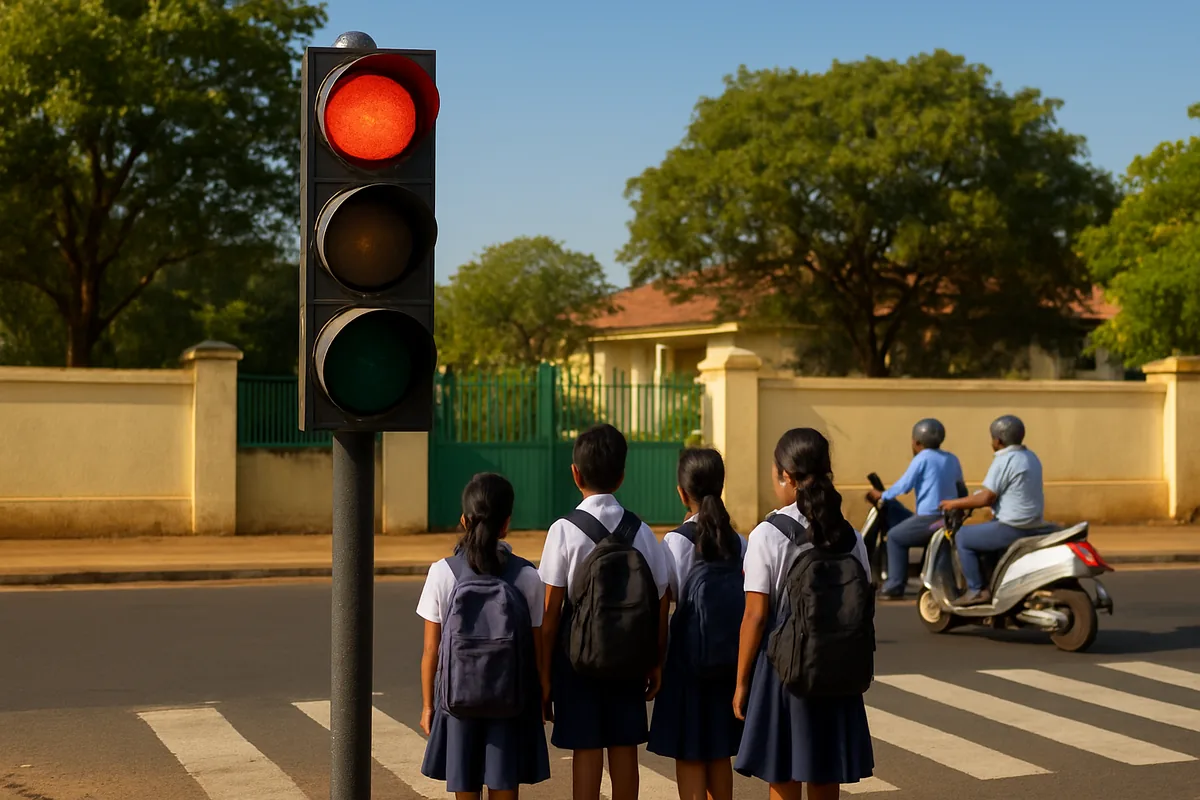
A school traffic light is a signal placed near a school gate or crossing that tells vehicles when to stop so children can cross safely: red means stop, amber means get ready to stop, and green means drivers may move if the way is clear. Walkers have their own small lamps: a red figure standing still tells them to wait, and a green figure in mid stride tells them to go. On this page children learn each colour, teachers get a ready traffic light activity in school, and everyone can try the live signal on this page by tapping its buttons.
Quick facts
Red
Vehicles halt behind the white stop line.Amber
The signal is changing. Drivers slow and prepare to halt.Green
Vehicles may go, but only after checking the road is free.Red figure
Walkers wait on the footpath.Green figure
Walkers cross on the zebra stripes, still looking both ways.
What each colour of a school traffic light means
Every signal in India stacks its lamps in the same order: red at the top, amber in the middle and green at the bottom. Children who cannot tell colours apart easily can remember the position instead.
| Lamp | Place | Driver does | Child on footpath does |
|---|---|---|---|
| Red | Top | Stops completely behind the line | May cross only if the walking figure is green |
| Amber | Middle | Slows down and gets ready to stop | Waits, never starts crossing now |
| Green | Bottom | Moves on carefully | Waits on the footpath, vehicles are coming |
Sometimes amber flashes on and off, often late at night. That means drivers should slow down and cross the junction with great care, because no one has a fixed turn.
The walking person signal for children
At many crossings near schools there is a second, smaller light just for walkers. It has two pictures:
- Red standing person: keep both feet on the kerb, even if the lanes look empty.
- Green walking person: you may cross now. Walk at a steady pace and keep looking left and right.
- Flashing green person: the time is ending. If you have not started, wait for the next turn. If you are already halfway, keep going calmly.
Some signals also count down the seconds or make a beeping sound for people who cannot see well. Some have a push button on the pole; press it once and wait patiently.
Why signals are placed near schools
Most schools open and close at the same time as offices, so roads around them get very busy. A signal stops traffic in turns so that a large group of children can cross together. It also slows vehicles that would otherwise speed past. Signals often stand together with the red warning triangle that shows two children; read about that sign on the school ahead sign page.
At busy times a traffic police officer or a school guard may stand at the crossing. Their hand signals are followed even over the lamps, because they can see what the light cannot.
A classroom activity with the three colours
This traffic light activity in school takes about one period and needs only coloured paper and chalk.
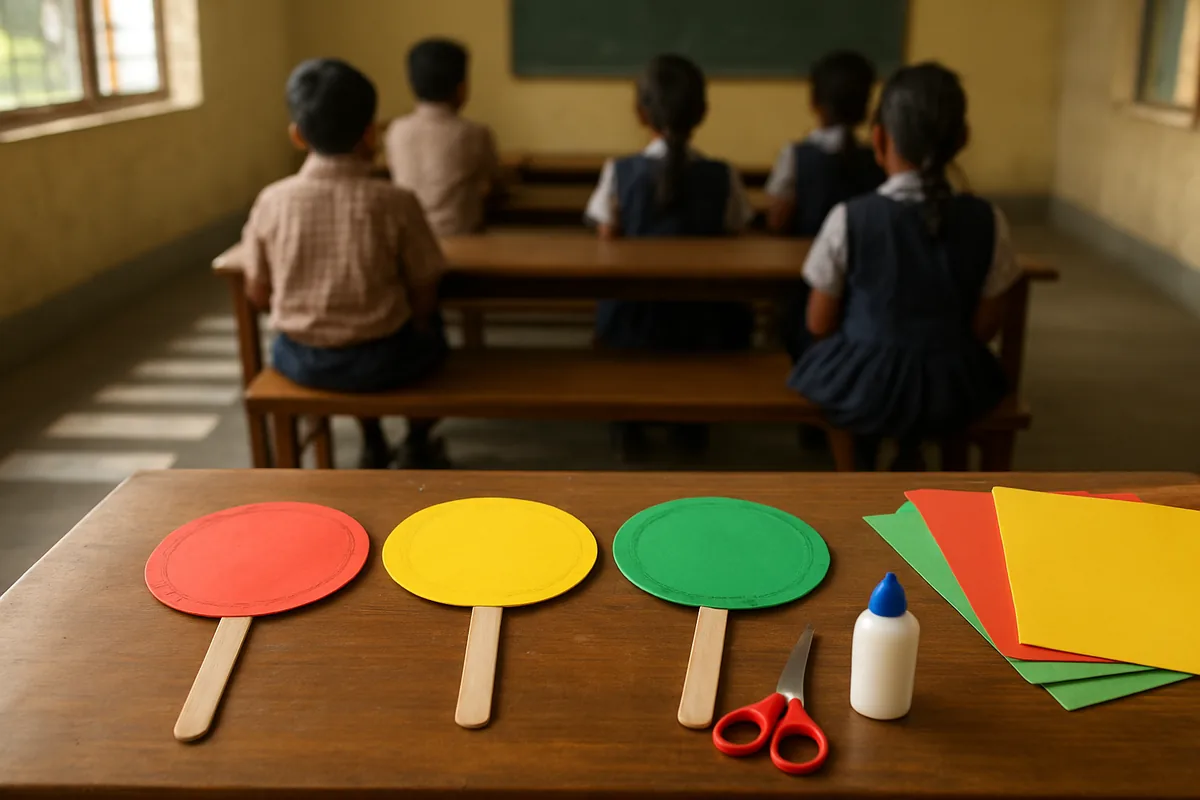
- Cut three large circles from red, yellow and green paper and stick each on a paper plate with a handle.
- Draw a zebra crossing with chalk on the floor or the verandah.
- Choose one child as the signal. The rest become cars, cycles, buses and walkers.
- The signal child holds up one plate at a time. Vehicles move only on green, slow on amber and freeze on red.
- When the plate is red, the walkers cross on the chalk stripes while the vehicles wait.
- Swap roles every few minutes so every child plays a walker and a driver.
End with three questions: who goes on red, who waits on green, and what should you do on amber? Children who enjoy it can make a lasting display using our classroom light chart ideas.
The red, amber, green game for the playground
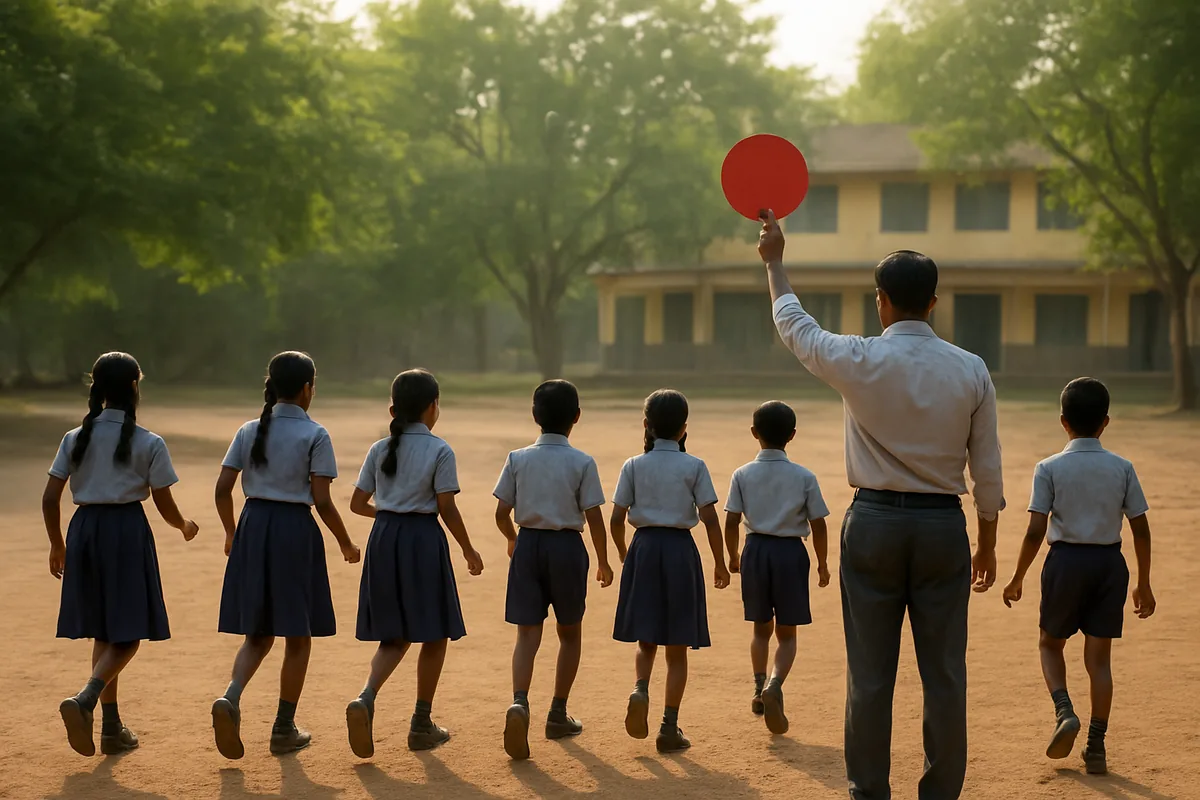
This running game builds quick reactions and teaches the order of the lights.
- All players stand in a line at one end of the ground. The caller stands at the other end.
- Green: players walk fast towards the caller. Running is not allowed, just like on a real road.
- Amber: players slow to tiny steps.
- Red: everyone freezes. Anyone who moves goes back to the start.
- Walking figure: players do a zebra walk with knees high, looking left and right.
The first player to reach the caller becomes the next caller. For older children, add a police officer who can overrule the colours with hand signs.
Simple rhymes to remember the lights
Short rhymes help young children remember the school traffic symbols. Clap along as you say them.
Rhyme one
Red on top says stop, stop, stop,
Amber in the middle, slow your hop,
Green below says go, go, go,
But look both ways and take it slow.
Rhyme two
Little man in red, stand still like a tree,
Little man in green, walk across with me,
Right and left and right again I see,
Safe on the other side, one, two, three.
Rhyme three
Helmet on my head, belt across my chest,
Waiting for the green is what I do best.
Ask children to make up a fourth verse about the school bus. It is a lovely way to check what they understood.
Make your own school traffic light
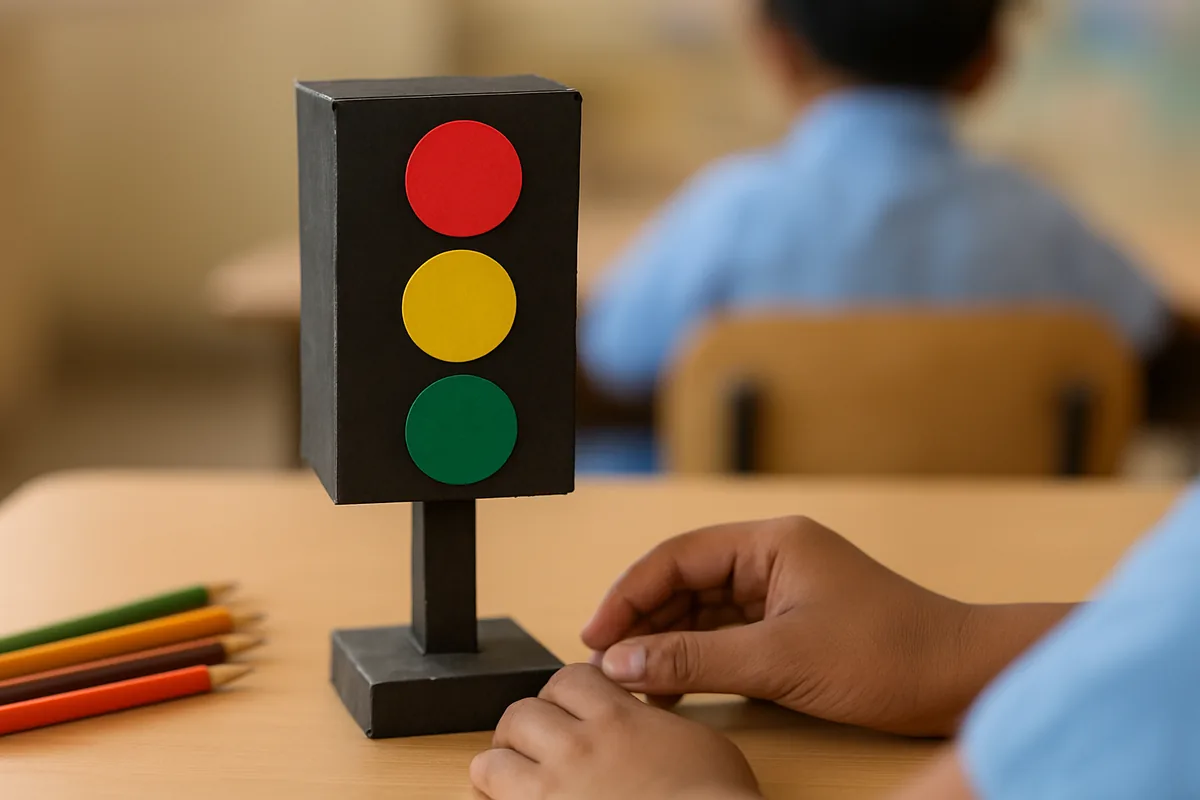
Once children know the colours, they enjoy building a model. A cardboard tower with three bottle caps is fine for little ones, while older classes can add LEDs and a battery. Step by step help is on the traffic light project page, and a science fair version that reacts to traffic is on the smart traffic light page.
For the wider set of road habits, from walking to riding in the van, see our road safety for students guide.
Questions people ask
What does a traffic light near a school do?
It stops vehicles in turns so children can cross the road in a group. It also slows down traffic in a place where many young walkers gather.
In what order are the colours on an Indian traffic light?
Red is at the top, amber in the middle and green at the bottom. The order is the same everywhere in India, which helps people who find colours hard to tell apart.
What should children do when the walking figure is flashing?
If they have not started crossing, they should wait for the next green figure. If they are already on the road, they should finish crossing calmly without running.
Who should we follow if the light and the police officer show different things?
Follow the traffic police officer or the school guard. Their hand signals are meant to take over from the lights when needed.
What is an easy traffic light activity for small children?
Use three paper plates in red, yellow and green and a chalk zebra crossing. One child shows the colours while the others act as vehicles and walkers, then everyone swaps roles.
Can a school ask for a signal outside its gate?
Yes, a school can request one from the city traffic police or the road department. They study the traffic and decide if a signal, a guard or a crossing is the right answer.